Monday, 31 October 2022

LLED 462: Assignment 1 Learning Log #3 Module 7: The Teacher Librarian as Educational Leader


Teacher Librarians: Unsung Heroes

Category: Quotes - Otonabee - South Monaghan Public Library

Image credit here

This week’ s module reminded me of the many hats we, as teacher librarians, must wear if we want to run a successful Learning Commons.   I remember how I used to think (a very long time ago…when I was in my first years of teaching) that being a teacher was a never ending adventure!  As teachers we have to wear so many hats at once and boy, do we need to be masters at multitasking or what?!  I used to dream about working at the library so I would not have to do a million things at once…I laugh out loud now thinking about how Naïve I had been! Being a teacher librarian is just like being a teacher but adding the rest of the school to your classroom! 

Image credit here

Just like Scott Douglas says, being a teacher librarian is not just about spreading love of reading and giving out information it’s “about serving a community.  And if the community if hungry for more than just knowledge, then maybe it’s about time to open a snack bar.” (Douglas, S. via UBC, Module 7, 2022)

Teacher-Librarians are educational leaders, inquiry superheroes, our problem-solvers, tech magicians, and book lovers.  They work tirelessly to ensure our students and colleagues have what they need to meet their learning needs.

Furthermore, as leaders, teacher librarians need to make sure to foster collaboration and networking within their school community.  This is no easy task, but very worth it once you start seeing the fruit of your hard work.  According to Trevor MacKenzie teacher librarians are "often under-utilized in a school environment.  Many teachers see the librarian interact only with students, but they are invaluable sources for teachers as well." (MacKenzie, 2019). One of our jobs as TLs is to promote our services to the school community as a whole.  Teachers won't know how much we can help them if we don't show them!  A word of caution though, we cannot go in "guns-a-blazing" and end up overwhelming them all.  We need to start small and go from there, perhaps collecting some resources that can help a grade 2 teacher with her science unit, or a pathfinder for Ancient Egypt, or offering drop in tech workshops to teach an app to the whole class, etc. 

Margaret Merga adds that "teacher and teacher librarian collaboration is a key feature of pre-service programs that seek to optimize student benefits." (Merga, 2019). But how can we open the door to collaboration?  I have listed a few suggestions in my presentation below.  The most important thing to remember is never to give up and to keep pushing, our students deserve it!

Networking is another key factor to consider when creating a great learning environment for our students.  Through networks, both teacher and students alike can find great resources and tips from like-minded individuals.  Networks also helps us stay aware of upcoming projects or professional development workshops.  They introduce new apps and programs to targeted audiences and they keep you informed of any changes around you.  In this digital era, networking has become a crucial player for us to help us stay connected with the world around us.  Teacher librarians need to continue to teach our students how to be good digital citizens and not fall prey to "information overload" or "digital misconduct." 

Networking Tips for Teachers: Building A Professional Circle | Resilient  Educator
Image credit here


Below is a compilation of my notes from this week’s readings about the importance to sustaining collaboration and networking in the library and the roles and characteristics of a TL as educational leader.

I used a program called emaze to share my notes.  One of my colleagues recommended this program and I love how user friendly it is! I can see how it can be added as a presentation tool for our students to use instead of Power Point or Pages.  You can also insert multimodal resources such as music, pictures, and videos to your presentation.  I highly recommend it! 

Without further ado, here is my emaze presentation on “The Teacher-Librarian: an Educational Leader.”  Just click on the picture below and it will take you to my presentation.  To view it better, make sure to click full screen.  If it's moving too fast, you can pause it at any time or go back slides by clicking the left/right arrows on the side of the screen.  Enjoy!


Image result for emaze


What do you think? Is there anything else we should add to the ever-growing list of  job titles? What else can we do to foster collaboration?

Until Next time,


The Duchess of Bookington


References:

Canadian Library Association. (2014). Leading learning: Standards of practice for school library learning commons in Canada.Links to an external site.  Ottawa: ON (p.17) see Fostering Literacies to Empower Life-Long Learners

Delvecchio, J (2022).  Module 7: The Teacher Librarian as Educational Leader: Supporting Networks and Partnerships in the Library. University of British Columbia

MacKenzie, Trevor. (March 18, 2019). "Classroom inquiry's secret weapon: the teacher-librarian." Canadian School Libraries Journal.  Retrieved from: https://journal.canadianschoollibraries.ca/classroom-inquirys-secret-weapon-the-teacher-librarian/
Merga, M.K.(2019).Collaborating With Teacher Librarians to Support Adolescents’ Literacy and Literature Learning of Adolescent & Adult Literacy,63(1),65–72.

Ray, Mark. (June, 7, 2016).  Changing the conversation about librarians.  Retrieved from: https://www.youtube.com/watch?v=IniFUB7worY

Surrey Teacher Librarian's Association (BCTLA).  (December 17, 2019). "What can collaboration with a teacher-librarian look like?" British Columbia Teacher Librarian's Association.  Retrieved from: https://surreychapterofthebctla.com/2018/12/17/what-can-collaboration-with-a-teacher-librarian-look-like/


Friday, 21 October 2022

LLED 469 Assignment 2: Curation


Resource Curation

Grade 2 Science Inquiry unit


Main Idea: water is essential to all living things, and it cycles through the environment

Content: 

Water sources

Water conservation

Local First Nations knowledge of water     

Inquiry question: Where does water come from? How is water distributed in our community? Why is water precious and limited? Why is it important in my community and how can we help conserve it?  What kind of relationship do First Nations communities have with water? Is it the same as yours or different? 

The following eleven resources have been intentionally compiled for their ability to support student learning and exploration of the inquiry questions: Why is water precious and limited? Why is it important in my community and how can we help conserve it? What kind of relationship do First Nations communities have with water? Is it the same as yours or different? 

These resources will support student inquiry and understanding of the importance of water for all living things through experimental, engaging, and authentic learning opportunities. 

Curation Process:

One of the easiest parts of this process was choosing the topic I wanted to use to create my inquiry unit.  Having taught Grades 1 and 2 for many years, I have always enjoyed teaching Science.  I love seeing our students learn through experiments, field trips, videos, and games.  However, I have always felt like I could do more to help our students further develop their inquiry mindset.  During LLED 469, I realized that some of the inquiry-based units I was teaching were certainly lacking some key aspects of the learning process; inquiry is not only “a way of learning that requires active engagement…it also involves reading, writing, speaking, and listening to learn.  The entire process is permeated with reflection and critical thinking.” (Strippling, 2004). Keeping that in mind, as well as making sure I consider inclusiveness, equity, and ways of learning, I have compiled a list of resources I believe will support student inquiry and understanding of the importance of water for all living things, our surroundings, and what we can do to help conserve it.  I believe that curating meaningful resources for our students is both worthwhile and critical given how this digital era makes it so easy for everyone to become victims of “information overload.”  Therefore, it is of great importance for educators and students alike to “develop skills that ensure that a rich and balanced array of learning resources -print, non-print, multi-media, digital, and human- are the foundations for inquiry.” (UBC, Module 6, 2022)  

Choosing good resources to support an inquiry-based unit is very important.  These resources need to provide students with credible, educational, multimodal, and easily accessible information.  Moreover, “the resources we choose will also have to take into account the following special considerations:

Support the learning standards or learning outcomes of the curriculum.

Assist students in making connections between what they learn in school and in real life applications.

Are developmentally and age appropriate.

Have effective instructional and technical design.

Meet the requirements set by copyright and privacy legislation.

Are suitable based on social considerations.

(UBC, Module 6, 2022)

Finally, I will also add another consideration to the list:

Give the opportunity to integrate First Nations ways of learning.

Most of the resources I have chosen for my curation have also been carefully selected keeping my students’ learning styles in mind.  According to Tomlinson, we need to make sure that our resources “give students ownership of their learning (and this is only achieved by) making sure that the learning fits the student: that the resources fit what the students are ready to do, that they (resources) connect with what students care about, and they allow students to learn and express learning in ways that facilitate their success.” (Tomlinson, 2008 p28)”  

Keeping all this in mind, I created the following set of questions that will help me choose good resources for my inquiry-based Water Conservation unit:

  1. Curriculum: is the resource correlated to the learning outcomes and unit objectives?
  2. Connections: does the resource give students the opportunity to make connections to the real world?  If fiction, is it easy for students to connect the story to real-life experiences?
  3. Developmentally and age appropriate: are the resources age- appropriate? Is it equally accessible to all students? Can the resource be adapted to fit everyone’s needs?
  4. Effectiveness: is the resource easy to use? Does it require extra time to teach how to use it? will students be able to access resources from anywhere?
  5. Copyright: has the school/district purchase a license for the resource? If so, is the login information available to students?
  6. Social Considerations: does the resource give students the opportunity to work in a group setting?
  7. Credibility: does the resource come from a credible source? Has it been reviewed? For First Nations resources: is it authentic? Does it depict issues that are important within First Nations cultures? Does it incorporate First Nations storytelling techniques and features as applicable? (Chrona, 2014)

Resources Retrieval:

It never ceases to amaze me the overwhelming about of information we have at our fingertips!  Just doing a quick “google search” and I was inundated with over 538 million search results!  I then went ahead and carefully read the learning outcomes from the BC Curriculum website and chose some key words to use on my searches.  Some of the words used were:

Water sources

Fresh water

Local reservoirs

Water conservation

Grade 2 water resources

Fresh water

First Nations connection with water

Local water conservation groups

Water conservation experiments

I did have difficulty finding proper First Nations resources, so I contacted our Aboriginal Education Support Worker, and she provided me with a list of approved websites and resources.  Some of the story books she provided can also be found in the Strong Nation website, I have already added a few to our cart to add to our LLC collection.

Once I started selecting resources, I decided to use Symbaloo as a pathfinder tool as “(it is) an intentionally curated director(y) of resource that (is) helpful to (both) students and teachers.” (UBC, Module 6, 2022).  I will continue to add more resources as I find them and curate them so teachers will have a nice collection to go to in the future.

Finally, the resources chosen are not only digital, but rather multimodal so as to give all our students equal opportunities and tools to learn at their own pace.  Technology use will be encouraged throughout the inquiry unit to help customize learning and to foster a learning environment where successes and mistakes are encouraged and celebrated.


Annotated Bibliography: 

(to access my Symbaloo platform, please click here)


1) ARMS: Stream Health (n.d.). Alouette River Management Society.

Accessed on October 12, 2022, from https://alouetteriver.org/ 

The Alouette River Management Society (ARMS) has developed a variety of educational programs for k-12 students following the BC curriculum.  Each program focuses on local ecosystems and waterways, making this resource very valuable as students can learn about water in their own “back yard” and community.

The program I am focusing on is called Stream Health, which is a hands-on experience, where experts from ARMS come to the classroom to help students explore various aquatic insects and how important these are for the preservation of our local waterways.   The program is 1.5 hours long and is interactive which is great to keep students engaged and learning.  There are also a variety of field trips you can take with the class as well as printed resources you can use.  The association also has a YouTube channel where you can access a number of educational videos.


2) K-12 Water Education Videos with Open Captions - YouTube. (n.d.).

Accessed October 14, 2022, from https://www.youtube.com/playlist?list=PLeod6x87Tu6c58Cg1iTykWwCqCz58xwut

This YouTube channel has a good collection of educational water videos, from the water cycle, water conservation, importance of water, to water safety.  What I really liked about this resource is that it is very engaging, colourful and has a lot of kid humour to keep students engaged.  It also has the option to turn on captions for the hearing impaired.  Having captions will also give students the opportunity to improve their reading skills as they read along with the video.  Having the whole channel as a resource as opposed to just one video will also give children the opportunity to explore more about the topic.  I can use this resource to help our students tap into their prior knowledge as they make connections and learn new facts.


3) Learn 360 District (2019). “Water Section”
Accessed October 15, 2022, from  https://learn360.infobase.com/

Learn360 District is an online database containing resources for grades K-12.  It provides a vast number of multimodal information, from audio files, videos, games, articles, to STEM activities, experiments, and maps/diagrams.  This website is easy to navigate, visually appealing, and age appropriate.  Everything you need can easily be found by typing “water” in the search box and filtering the search to the age group you are searching for.  Students can further develop their searching skills by learning how to use the filter option at the top of the page; it is very simple to use and can be taught at the beginning of the lesson.   The experiments on the site provide opportunities for students to work in groups, further developing their social skills.


4) SD42 Library Reference Set: Water
Gibeault, I. (n.d.). LibGuides: SD42 Libraries Elementary Reference Sets: Water (SC 2). Gss.sd42.Libguides.com. Accessed October 19, 2022, from https://gss.sd42.libguides.com/c.php?g=698159&p=4995164

The SD42 Library Reference Water Set is an online collection of resources curated by the Maple Ridge Teacher Librarian’s Association (MRTLA.) This online database provides students and teachers with a set of multimodal resources that support the Grade 2 learning outcomes and goals found in the Science BC Curriculum.  One of the benefits of this multimodal resource is that it is addressing various learning needs.  Moreover, it also provides links to First Nations resources and videos which can help teachers include First Nations Ways of Knowing and Learning.  Finally, a list of picture books has also been added using our district LS2 database making it easier to find them in our Learning Commons.  This online resource will also help us further develop our students reading, writing, researching, and technological skills as they navigate through the resources.


5) National Geographic Kids: Make an underwater scope. (2017, June 26). 

National Geographic Kids is an online and printed magazine published by the National Geographic Society.  It is geared towards children ages 6 and up and offers a variety of activities for kids to explore.  From games, experiments, videos to scientific articles written in age-appropriate language, this website is a great resource for primary students.  The website offers a variety of visually appealing and engaging informative articles about the importance of water, water cycle, conservation, and fun facts.  One of the articles I will be using is called “Does Canada need to conserve its water?”  I find this resource invaluable as it gives you the option of printing it, reading it for you, or watching the video; students will be able to choose which option to use according to their learning needs. STEM Experiments like Making an underwater scope, build your own water filter, and funny fill-in online water facts, can be found in their database by simply typing “water” in the search bar.  Furthermore, because of the variety of formats this resource has, students will be able to learn about the importance of water, and at the same time, continue to improve their reading, writing, speaking, and technical skills.


6) Hydro, B. C. (n.d.). Grade 2-3 Drops of wisdom. BCHydro Power Smart for Schools. 

A Lesson created by BC hydro Power Smart for Schools, which shows the relationship First Nations People have with Water. The lesson contains a slide show which invites students to explore how First Nations People respect and take care of water.  It also shares important cultural ceremonies they preform using water.  The language use is age appropriate and the pictures are very colourful and informative, which will help keep students engaged.  Throughout the slideshow, students are given the opportunity to discuss their ideas with their classmates and to write them down either individually or as a class.  Teachers have the choice to print out a worksheet for students to draw or write down three important ideas they learned from First Nations People’s relationship with water.  With this resource, students will be able to further develop their critical thinking, note-taking, social, and summarizing skills. 


7)Value of Water Canada: Classroom Lessons. (n.d.). 
The BC Water and Waste Association has created a website called “The Value of Water” to help raise awareness about contributing factors to our ongoing problem of wasting water.  It calls for the renewals of our current water systems in order to protect our health and environment.  This website offers a compilation of multimodal teacher resources to help raise awareness of where water comes from, how we get it, and where does it go after we use it.  The resources are grouped by grade level to make it easier to navigate.  Furthermore, it has a section of virtual and in-person field trip ideas for schools.  The in-school field workshop I have chosen is called “Water, Water, everywhere?” where students will have the opportunity to become water rangers and explore where water comes from. The workshop is valuable as it provides students with opportunities for experiential learning through videos, hands-on activities, discussions, and class challenges.


8) Robertson, J. (2017). The Water Walker. Second Story Press.

This books is the 2018-2019 winner of the First Nations Communities Read Award.  It depicts the story of an Ojibwe grandmother and her battle to raise awareness of the need to protect Nibi (water) for future generations.  Nokomis, along with other members of her community, have walked around all the Great Lakes to raise awareness about the need to protect our water and our planet for all our future generations.  Joanne Robertson is AnishinaabeKwe and a member of Atikameksheng Anishnawbek.  She has written other books about the topic in both English and Anishinaabemowin (Ojibwe).  This resource is very valuable as it’s reflective of the Indigenous ways of sharing knowledge and understanding through stories, it also raises awareness of other controversial topics (lack of water in indigenous communities, equity, and the way First nations People are still being treated) in an age-appropriate manner, by using age-appropriate language, colourful pictures, and kid humour.  The book also shares a link to Joanne Robertson’s website called Mother Earth Water Walk, where you can find videos, news, pictures, and a song to “Nibi” in Anishinaabemowin (Ojibwe) we can share with students.  


9) Breakout EDU - Educational Games: Water, Water Everywhere. (n.d.)
Retrieved October 17, 2022, from 

Breakout Edu is an online database of interactive games that students can play individually, in groups or against each other.  Teachers are able to sign up for free or you can pay a fee for the premium version.  Some of the features this site has are: assign games by subject and grade, keep a scoreboard of the class, save favourite games to be played later, and many more.  Students can search games on their own as it is very easy to navigate.  The game I chose is called “Water, water everywhere…until it’s all gone.” It can be played in groups or with big buddies, the final objective is to break into the evil scientist lab before he melts the ice caps and distribute the water to countries in need of fresh water supply…this cannot happen as it will have devastating impacts on our planet.  This game is sure to keep students entertained, the fast-paced atmosphere will keep them engaged; their critical thinking, fact-checking, and social skills will be further developed as they try to break the code and win the game.  Finally, there is also an easier version of the game called “water, water everywhere” geared towards younger students. 


10) Water. (2022). In World Book Kids.

An online database that offers students and teachers a variety of age-appropriate multimodal resources such as videos, articles, diagrams, audio files, games and more.  It can be used to further develop student’s research, critical thinking, navigating and note-taking skills as they navigate through the easy-to-follow site.  One of the features I like is that every article has a tab at the top where teachers can find the curriculum standards and learning outcomes making it easier for them to make sure students learning goals are being met.  Furthermore, the articles have the text-to-speech feature which allows students with reading difficulties to equally access the information as the rest of their peers.


11) Project WET Discover Water. (2018).
Accessed on October 20, 2022, from https://www.discoverwater.org/

This website has been designed for educators, parents, and most importantly, for children ages 7-12.  It is a self-directed educational resources which explores various water topics, including where it comes from, conservation, water cycle, etc.  The website is very kid-friendly and easy to navigate.  Each topic has its own icon, once you click it, it gives you various multimodal resources, from videos, games, read alouds, to sections where educators and parents can access printing material, books and other resources.  A very neat feature is the “science interactive notebook,” which you can find in every section.  This notebook can be printed so students can take notes, draw diagrams, and write questions as they explore the topic they are learning about.  Another feature is the talk-to-text which can help meet many of our students’ learning needs.  This is a great resource to help students continue to develop their navigation skills as well as their social, critical thinking, fact-checking, and inferring skills. 


Works Cited:

Building Student Success - B.C. Curriculum. (n.d.). Curriculum.gov.bc.ca. https://curriculum.gov.bc.ca/curriculum/science/2/core

Chrona, Jo-Anne, Authentic Resources and Appropriation. (2014, November 26). First Peoples Principles of Learning. https://firstpeoplesprinciplesoflearning.wordpress.com/authentic-resources/

Hussief, L. (2022).  Module 6, LLED 469. University of British Columbia, BC


Strong Nations - Indigenous & Native American Books, Aboriginal Kids Books, First Nations Kids Books, Inuit, Métis - Building Strong Nations Together! (n.d.). Www.strongnations.com. https://www.strongnations.com/

Tomlinson, C. A. (2008b). The goals of differentiation.  Educational Leadership 66(3): 26-30 retrieved form: https://www.ascd.org/el/articles/the-goals-of-differentiation

Valenza, J. (2012) Curation.  School Library Monthly. 29 (1): 20-23 retrieved from:


Wednesday, 19 October 2022

LLED 462: Assignment 2 Libraries as Centres for Literacy


 “Reading transcends class, race, age, and gender. It’s a free magic carpet ride to anywhere on Earth (or beyond), at any point in time. Every child, regardless of age or ability, deserves to be able to access the written word.” (Hawthorne, 2021.)

Plato - best quotes on the importance of books
Image credit here

Reading has always had a very special place in my heart.  Not only because it brings back beautiful childhood memories, but also because it was my escape during what I consider the darkest moments of my childhood.  It was my place of comfort while I grieved the loss of my mother, and my happy place where I could be anyone, do anything, and live many lives through the pages of a book.  Now that I am a grown up, I continue to love reading and have made it my mission to help create a reading culture within our school.

But what does it really mean to have a strong reading culture in our schools?  And more importantly, how do we know we are on the right track to achieving this?

In her article “How to promote a Reading Culture in School,” Hannah Hawthorne defines a reading culture as “the environment where reading is championed, valued, respected, and encouraged.”  She goes on to add that “reading lies at the heart of the curriculum and it’s of the upmost importance to a child’s personal, social, and academic success, as well as their general wellbeing… building a strong reading culture puts reading at the forefront of school improvement. A creative and exciting reading culture not only breeds capable and committed readers, (but it also) boosts wellbeing, community connectedness, and student outcomes.” (Hawthorne, 2021) 

We have a very important job as educators and teacher-librarians and that is to provide as many opportunities as possible for our students to access the “written word,” of course by written word I don’t mean only books, but also a vast number of multimodal resources.  The more exposure our students get to the written word, the easier it will be for them to see themselves as belonging in a community where reading is a significant and enjoyable activity.  On the other hand, we must also keep in mind that “being surrounded by cultural forces that fail to support reading or diminish reading outright erodes students’ interest in reading and prevents them from sustaining any reading motivation.” (Kelly & Miller, 2013). As TLs, our job is to ensure this does not happen and that by helping build a strong reading culture within our school community, we will “put literacy at the forefront of school improvement.” (Hawthorne, 2021)

Having taken a few courses already for my Teacher-Librarianship Diploma, I have come to understand the many benefits of having a strong reading culture in schools.  Many questions keep popping in my head as I read more and more about literacy and the learning commons.  Some of those questions are:  Why are literacy rates dropping in this day and age?  How can we help the 21st century learner be successful? What can the learning commons do to help our school community create a reading culture everyone is proud of?  

Before I lay out my 2-year literacy plan for our learning commons, I must first discuss the importance of literacy for our students today, how our Library commons can become a centre for literacy, some things to consider when planning my goals, and possible setbacks I may encounter along the way.

What is Literacy and why is it important?
According to the Thesaurus, literacy is “the quality or state of being literate, especially the ability to read and write.” (Thesaurus, 2022). However, upon closer examination, you will see that the word literacy is more complex than that.  Literacy is the ability to communicate and interact with those around us. Amber Peterson from the National Council of Teachers of English adds that literacy is the “way that we interact with the world around us, how we shape it and are shaped by it. It is how we communicate with others via reading and writing, but also by speaking, listening, and creating. It is how we articulate our experience in the world and declare, “We Are Here!” (NCTE, 2020). John Trischitti takes it a step further in his TED talk called “Literacy is the answer”, he says that “If literacy were a disease, we would be going through the worst pandemic in recorded history…but unlike a disease like diabetes or cancer, this one does have a cure…literacy is a necessary tool to stop social cycles like poverty, crime, hunger…illiteracy is the one factor that can potentially influence your entire life.” (Trischitti, 2020). He goes on to add that “traditional education is important, but reading is the foundation upon which all other essential skills are built.” 
If you would like to listen to his TED talk click on the picture below.


Literacy is vital if we want to provide our 21st century learners with the necessary skills if we want them to be successful in the future.  Nowadays, our students are being bombarded with multimodal contexts left, right, and center; this can be very intimidating and potentially catastrophic if they do not know what to do with all this new information.  
Studies have shown that children will need higher “levels of literacy in so many aspects of their lives.  Everywhere (they) look, there’s a sea of information for them to digest – in school, at home, on public transport, on the roads, and on digital technology interfaces.  Not only is reading required for success in future employment, but an ability to read will help children in future relationships, when running a household, and when navigating all aspects of their personal lives.” (Hawthorne, 2021)

Our job as educators and teacher librarians is to provide these students with the necessary skills to be able to digest, dissect, and access various modes of communication, from books, videos, news, to the latest technology out there.  But how can we do that? As Teacher librarians, we are in a unique position to become the vessels of information our students need.  By creating vibrant literacy programs within our school community, promoting our school learning commons, enlisting the help of our community, and by engaging our students and allowing to have access to deeper learning skills; we will help them build a thriving community where we all celebrate learning and successes as they learn to question, make connections, create, think critically, collaborate, construct new meaning and most importantly, make mistakes and learn from them.

So how can the School Library Learning Commons become a Centre for literacy our students will thrive on?  How can both TLs at our school help our community reach our literacy goal in the next two years?

Let’s back track a little before I answer these questions…

Background

Our school is a dual track school built on the Ancestral, Traditional and Unceded share territories of the Katzie First Nation and Kwantlen First Nation.  We are currently sitting at 99.4% capacity, with a student body of 624 plus approximately 75 staff members, including educators, educations assistants, admin, receptionists, non-enrolling teachers, CSW, counsellors, custodians.  Many cultures are represented within our walls, from First Nations to up to 35 different countries.  Our ELL population has steadily increase in the past two years with more than doubling in the past year.  Socio-economic status varies from one end of the spectrum to the other.  We offer breakfast clubs, lunches and the “star backpack” program, where we give backpacks with food on Fridays to families in need.  

Last year, our student learning survey indicated that about 47% of our student population reads for fun regularly.  Our main literacy goal is to increase that to 60% by the end of this year and 70% by the end of the 2223/24 school year.

 
Our Library Learning Commons

What is a Library commons? 
According to the Canadian Library Association, it is “a whole school approach to building a participatory learning community…(it) is the physical and virtual collaborative learning hub of the school. (A place where) reading thrives, learning literacies and technology competencies evolve, and critical thinking, creativity, innovation, and playing to learn are nourished.” (CLA, 2014). It is the heart of the school, the place to be, a hub of learning.  And just like the SLLC is the heart, literacy is the blood that makes the heart beat and bring life to the community as a whole.

Furthermore, Leading Learning tells us that Learning Commons are not only the hub of the community but also that “our school libraries should reflect our common values of equity, diversity, and cultural identity as well as best approaches in the educational and library professions.  They should be contextually relevant to student needs and success, and built, cared for, measured, renewed, and sustained on an ongoing basis by their learning communities.  We should position libraries to lead learning for the future.” (CSL, 2014)

Prior to my job share partner and I taking over, our library was mostly used for book exchanges.  Sadly, I can count with one hand the number of times I walked through those doors by myself or even with my class for other things besides a book exchange.  To be honest, I was a little afraid of approaching our TL.  Don’t get me wrong, she was a lovely lady, and we would talk often in the staff room, but I would never go inside the library to talk and if I needed resources I would send an email.  It was like there was a wall surrounding the room and no one could enter.  I now realize with regret all the untap potential I missed out because I did not take the extra step and approached her.  Fast forward to when my job share partner and I took over, I was surprised to find out that I was not the only one who felt that way! So, we set out to change that.  As we know, the learning commons is the hub of the school, the heart, the place to be…” a common or shared space that is both physical and virtual…it allows users to create their own environments to improve learning…it’s about changing school culture and transforming the way teaching and learning occur.” (Loertscher, Koechlin & Rosenfeld, 2012, 1)

With all this in mind, we created a plan to turn our learning commons into the hub of the school, a welcoming place where the doors are always open, where no class will be turned away and if needed, we can accommodate up to 3 classes while doing book exchange at the same time.  We are very lucky that our library is one of the biggest in the district.

Our school library began its transformation into a learning commons and underwent through significant changes in terms of layout and book collection.  To this day, we are still investing in some physical changes and furniture, but sadly as we all know, money does not grow on trees, so we have had to get creative in how we tackle certain things.  We have added comfy seating, lamps, plants, a campfire corner where we sit for story time, soft music playing in the background, etc.  We want our students and staff to feel relaxed, welcomed, happy, safe, and most importantly, a sense of belonging.
Our library collection has also started to change and grow in the past year as well…one of our main goals as a school is to make sure everyone in our community is represented equally.  We have acquired many First Nations books, and other culturally diverse stories as well as more multimodal resources such as games, graphic novels, apps, etc.


Atrium
Genrefied Easy Chapter Books section

Reading nook
Bean Bag Corner   


Easy Picture book section

Our Fireplace Reading Corner


Literacy Plan

The Canadian Library Association notes that the themes of “Literacy Leadership, Engaging Readers, Information Literacy, Critical Literacy, Digital Literacy and Citizenship, Cultural Literacy, and Literacy partners” are key elements when creating a well-balanced literacy program within our schools that will aid us in creating an environment that will “empower life-long learners.” (CLA, 2014) 

Image credit here

Currently our LLC schedule consists of 20-minute blocks for book exchanges, a 40-minute co-teaching block available on Friday afternoons, 2 40-minute library prep blocks, 2 60-minute remedial reading blocks (outside the library) and 2 40-minute PE prep blocks.  The remedial reading blocks and PE blocks are new this year and have decrease our library time by 4 hours weekly.  This means we (my job-share partner and I) have had to get creative and juggle around to continue to provide a somewhat flexible schedule for our community.  Our theme this year is tied to our school theme of “The Stories that bring us together.”  The main goal is to continue to engage readers, create a life-long love of reading, reinforce our students’ reading identity, and create a culture where reading is not only encouraged by held to a high standard.  Therefore, I will be concentrating mostly on the CLA standard of “fostering literacies to empower life-long learners” when setting our SLLC literacy goals for the next 2 years.

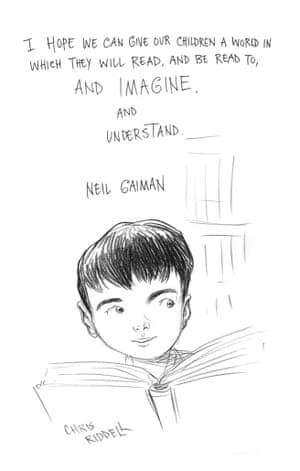
Page 19 of Neil Gaiman and Chris Riddell’s book Art Matters. ART MATTERS by Neil Gaiman, illustrated by Chris Riddell is published by Headline on 6th September
Image credit here

Kelley and Miller make a great point when they say that “if we want children to read more, we must provide them with classrooms, libraries, and homes where reading is the norm.  If cultural acceptance includes wild reading, then children will read.” (Kelley &M Miller, 2013). Furthermore, we know that society benefits when more people read… “people cannot be active or informed citizens unless they can read…reading is a prerequisite for almost all cultural and social activities.”   As TLs, our main job will be to help build a strong reading culture within our school community; doing this will put literacy “at the forefront of school improvement.” (Hawthorne, 2021). However, it is important to mention that this job does not solely fall on the two of us.  Hawthorne reminds us that “creating a reading culture should not be the responsibility of an individual.  It takes dedication, perseverance, and effort.  It’s lead by an enthusiastic and dedicated senior leadership team, and advocated by every pupil, parent, care provider, and staff member in (our) school community.” (2021) We are very lucky that our admin team is very supportive and have jumped in with both feet to a lot of our suggestions.  This in turn has made it easier to enlist the help of more staff and the PAC.

According to the CLA standards, our Learning commons is currently sitting between the emerging and evolving category since approximately 47% of our students are mostly able to “self-select reading texts from the collection and report that they enjoy reading for pleasure.” (CLA, 2014 p17). Furthermore, our students also participate in virtual and face-to-face reading programs.

Knowing where we are at and where we would like to go, I have come up with three literacy goals which I know will help our school-wide literacy goal of “increasing the percentage of student population who love reading for fun by 20% by the end of the 2223/2224 school year.”
The goals are:
1) Continue to foster a school-wide reading culture by making reading opportunities more accessible to all.
2) Improve digital literacy for staff and students
3) Increase school community involvement in various literacy programs

So, what are we currently doing to not only achieve our goals but to also continue to foster a reading culture within our school?  

Like I have already discussed, this is not a one-person job, we have slowly enlisted the help of our staff…it has taken time but like I already mentioned, we were on a mission to change the image of our SLLC.  I’m happy to report that our “sneak attacks” have worked so far. 
Some of the approaches we have taken and continue to take this year are:

Community Storytime: Every Sunday evening, our school parent Facebook page goes live and one of our staff members reads a story online.  We started doing this during the pandemic and received such great feedback that we have continued to do it.  We usually ask for volunteers during our staff meetings for the upcoming month (I must add that this took a few months as teachers were very hesitant, we even suggested drawing names, and this really got them going…that was one of our sneak attacks! We also offered to pre-record the video and post it online on Sundays, this made some of our teachers feel more comfortable as they would not be live.  We have had from our admin to our favourite custodians join in the fun! We announce every Friday over the PA who will be our guest reader that weekend and invite the community to join us.  One thing to note is how great it is for the children to connect with staff they do not usually see in the building during school.  This to us is important when creating a love for reading as they see every adult in the school indulging in some reading fun.

Principal/ vice-principal Read alouds: we have created a sign-up sheet and placed it in the staff room where we “rent” our principal and vice-principal to a classroom to read a story.  We have created a very flexible schedule for them where there is a chance once every couple days for one of them to go for 15 minutes to a classroom. This has taken a bit more work as our admins are always busy; however, we are happy they both jumped in at the opportunity to continue to foster a love of reading in the school and make every effort to make it to the classrooms at one point during the day.

DEAR: as a school community, we have allocated 15-20 minutes after lunch for silent reading.  How it plays out, is at the teacher’s discretion.  During this time, we open the library for any classes who would like to do their DEAR there.  We are very lucky to have a big space and can accommodate up to 3 classes at a time.

Stop, Drop, and Read:  we started this campaign a year and a half ago.  How it works is we play a song in the PA, and everyone stops what they are doing and picks up a book.  We then read as a whole school for about 15 minutes until Admin announces the end over the PA system.  We had a few setbacks at the beginning as sometimes teachers were outside and had to go get books, or were at the gym, etc.  We solved this problem by creating book bins and book bags and placed them in the gym, music room, support rooms, the office, and by the outside doors so teachers would always have access to books.  I just love how for that time; the school is so quiet you can hear a pin drop…and knowing that this is because everyone is reading makes your heart warm for sure! Due to time constraints, we have decided to do this 3 times a year for a week.  Students, staff, and families have responded positively to this reading campaign that we continue to do it.

Remedial reading groups:  the learning commons continues to work with our support teachers to create reading groups where the TL, support teacher or EAs work with students on reading strategy and phonemic awareness.  This year, our admin has also allocated 2 hours per week of library time where we can work with these groups uninterrupted.

Book displays: Children are curious by nature, so we like to exploit that by creating colorful displays of some of the books in our collection.  Our SLLC is surrounded by windows, so we like to display a variety of books for children to see as they walk in the hallways.  Our idea came from “window shopping.”  We know that people are drawn in by what they see on shop windows, so we wanted to do the same at our school.  Our newer books are never able to stay in the library for long as children see them on the display and come in to sign them out.  We also have books on top of our shelves and have genrefied our Easy Readers section so our youngest readers can find the series or genre they are looking for by themselves. We want our readers to gain independence and take ownership of their reading identity.  According to Kelley and Miller, if we want our readers to be more independent “sometimes the best thing to do is get out of their way…if students depend on our validation for every book they read, they aren’t reading for their own purposes and needs.” (Kelley & Miller, 2013). 

Culturally diverse books:  This is an ongoing project as we strive to find resources that are inclusive of the diversity represented at our school.  Last year, my job-share partner and I watched a Ted talk for one of our courses, where author Chimamanda Ngozi shared the dangers of “a single story.”  She notes that “the single story creates stereotypes, and the problem with stereotypes is not that they are untrue, but that they are incomplete.” (Adichie, 2009) This really struck home for us as we realized that our collection was not as diverse as we once thought.  We have slowly started to add more culturally diverse resources to our collection.  We now understand the importance of helping our students see themselves in stories.  The more they connect with the characters, the more they enjoy reading.  And the more they enjoy reading, the more they will be able to improve their academic success and their life.

LVE’s Monthly pick:  This program works like “Heather’s Pick” at Chapters.  We give a card to each staff member at the school, and once a month (Usually during Pro-D days) they get to come down to the learning commons to look for one of their favourite stories.  We then display their picks around the library and by the windows so students can see what their teachers like and can sign the books out.  This also helps us make connections with our students as they learn that some of their favourite stories might be a teacher’s favourite too.  A setback is that teachers have no time sometimes to come in and pick a book, or they feel obligated or overwhelmed by adding more to their plate.  What we do is ask them to think of a list of 5 books or authors and we look for them in our LLC, we then earmark them and can change the books for them so they do not have to come down if they are too busy.  

Bookstagram:  This is a bulletin board we change every couple weeks.  We ask staff and students to tell us what they think about books they’re reading and if they recommend them. Kelley and Miller point out that “the number one way children find out about books they would like to read is through recommendations from other readers.”  On the other hand, sharing recommendations also benefits the reader as they reflect about the reasons why they liked those books. Keep in mind that by “reflecting on our book recommendations, we can discover a lot about ourselves and what we value about books.” (Kelley & Miller, 2013)  


Google Slides Bookstagram Instagram Independent Reading Bulletin Board  Template


Bookfest/Reading link challenge: Two of our major events at the Learning commons are our annual Bookfest for grade 6/7 students and our Reading Link Challenge for grades 4/5.  Bookfest is District wide, so all elementary schools participate.  For Bookfest, participants are asked to read 6 books in total, we meet once a week and create Ka hoot quizzes to check for understanding and prepare for our final “showdown,” an event like “Jeopardy,” where schools go head to head competing for the grand prize: funds for books for our learning commons, a pizza party, a nice trophy which can be displayed at the winning school for a year, and an author visit from one of the books.  Last year, due to the pandemic, we have had to hold our event online and even had to deliver Ipads to the classrooms for small groups to participate as we were not allowed to combine classes.  We are so happy that this year, fingers crossed, we will be able to be together once again in person.  
Reading link is a community-based effort to promote reading.  It is hosted by our Local Library and schools can sign up to participate.  Students are required to read 4/6 books and just like Bookfest, we get together once a week and practice for our final competition.  Prizes include new resources for our learning commons as well as the title of Reading Challenge Champions for the region.  To learn more about it click here.   Last year, as my final project for one of my courses, I created an online book for our school to use to prepare for the challenge.  I used the program called Book Creator to create online quizzes, created book trailers for all participating books, and an introductory video.  I used it with our learning commons, and I am so pleased with the results that I am already starting to think about creating a new book for this year’s challenge. You can check out the online book by clicking on the picture below.


In the next two years, we are hoping to implement even more events to achieve our literacy goals.  One of our main objectives is to start involving our school families and surrounding community to reach not only our students, but the people they encounter outside our school walls.  We need to keep in mind “how cultural factors affect students’ views towards reading and evaluate how implicit and explicit messages from adults influence students’ reading lives…how do parents view reading? What role does reading play in our school culture? How do we make reading ordinary and expected in children’s lives?” (Kelley & Miller, 2013) By making this a “community effort” we are not only showing children how important reading is, but the community as well.  But how can we achieve this? Below is a list of some of the things we are planning on doing.

Add reading nooks around the school: we would like to create visuals around the school to spark curiosity within the school community.  One of our ideas is to create reading nooks throughout the school where we invite children and staff to take a break if needed and read a story.  These do not have to be elaborate: a beanbag, small comfy chair, or a cushion with a basket of books or a small bookcase.  We have many little corners that could work.  One of the setbacks we see is that some of the children might use these as toys or they could pose a safety issue if the chairs are used to hit others.  We are currently discussing as staff how we can go around these issues.  Some solutions are to use only cushions to start and baskets, ask teachers to show their class how to use the reading nooks or my job-share partner and I can go to every classroom to show them, inviting students to use them during our announcements and reminding them about the expectations, creating visuals around the nook showing them what to do.

Human libraries: Christine Watkins notes that “Human libraries provide the opportunity for the community to share and understand the experiences of others in their community” (Watkins, 2014).  The “human books” come from all walks of life and bring many experiences and expertise.  These types of libraries will bring oral history, another way of learning, into our learning commons.  It’s important to note that “by providing access to otherwise difficult to obtain knowledge embedded in community members, human libraires have the potential to generate new kinds of knowledge and experience sharing while providing new access into local history and cultural heritage.” (Dobreski & Huang, 2016) I am really excited to start organizing these events.  We have already discussed it with PAC, and they have offered to provide refreshments for our guests, and many have offered to volunteer to be part of the event.  We are hoping to bring in guests from our local First Nations communities, community workers, veterans, local government figures, etc.  One of our major setbacks will be availability of participants.  We are planning to start small by inviting one guest and expand from there.  We will also be posting in our social media accounts calling for volunteers to take part in our project.  We might even call our local newspaper to write a column about our project and ask for volunteers.  With patience and a lot of effort, we will be able to slowly create a unique “collection” for our students to experience.
 
Book fairs: Due to the pandemic, we had not been able to organize a scholastic book fair for our school.  This year we are planning to organize one and by next year, host two fairs.  We know that not everyone will be able to participate due to financial constraints, but we are hoping that some of the money raise can go to us creating small book bags to send home to our school members who need it most. 

Community book swaps: “when schools close down for the summer, many children, particularly children of low-income homes, do not have access to books.” (Kelly &Miller, 2013). We would like to change that by hosting an annual book swap.  We will start sending out information to all our school families and even local businesses to donate gently used books to our school.  We will also use some of our school funds and possibly have school fundraisers to purchase more books to add.  In June, we are planning to invite students and families to come browse our book tables and take home what they would like.  We will set a maximum number of books to take as we want to give all our school families equal opportunity to access books!  We will also encourage them to swap books with school families once they read them. 

“Rent-a-grown-up” program:  Prior to the pandemic, our school had hosted monthly days where we would have grandparents come a read with children around the school.  We would like to start this program again but also add other family members.  It’s important to note that “when (adults) read books with children, rather than to children, children listen more carefully, think more deeply, and engage more creatively with stories.” (Bright Horizons, 2021) Our objective is to reach out to our families and see if we have some volunteers to come in.  Security and safety of our students is very important so we are in the process of talking with our admin about ways we can ensure this.  

Big buddy reading program: We have already started talking with support teachers and staff about organizing a weekly “school stop, drop, and read” program where our intermediate students will come to our primary classes and read with our younger kids for 15 minutes one morning during the week.  We would pair up buddy classes to make it easier for teachers.  Some of our setbacks might be “attendance and tardiness.”  We will address these by having teachers assign children without a big buddy or little buddy to other groups.

First chapter Fridays: We would like to spark curiosity in our readers by sharing the first chapter of a book on the PA system every couple weeks.  Gaiman tells us that “the simplest way to make sure that we raise literate children is to teach them to read, and to show them that reading is a pleasurable activity.  And that means, at its simplest, finding books that they enjoy, giving them access to those books, and letting them read them.”  (Gaiman, 2013). The simplest way to do this is by sparking their curiosity in new genres by reading a few pages from books once a week. 

Digital literacy pro-D workshops and units for staff and students: the 21st century learner is now surrounded by digital outlets that are constantly changing.  Many Canadian school boards are focusing on training students to use technology instead of providing them with opportunities that will not only teach them how to use the tools but will enhance their learning experience (Loertscher & Koechlin, 2012). Furthermore, some staff are still very hesitant about using technology in the classroom.  We would like to change that by organizing workshops where we could teach them how to use some of the tools available to us.  We can start by creating “kits” for teachers using Web 2.0 apps that could be used in their classrooms.  When teachers learn how to use them and see how they can be used to maximize learning, they will be more willing to use them.  We will also offer to come to their classes to teach students how to use them and will open “shop” a couple times a week to provide tech assistance.  We are also hoping to create our own “Tech Squad” by the end of the second year.  This squad will be led by the LLC and will have students from grade 6/7.  Our job will be to provide simple tech assistance to staff around the school.  Our IT department will continue to take care of our bigger tech issues but things like, how to use book creator or tools from Web 2.0, can be taken care of by our squad.  This will also give students ownership of their learning as they assist others and will help them develop social skills.

Literacy seminars for parents: According to Kelley & Miller, “educating parents about the importance of daily reading, increasing book access through libraries and book ownership, and promoting the value of reading aloud must take prominence in parent outreach programs.” (Kelly & Miller, 2013) We need to teach parents simple ways to incorporate more reading into family routines.  We need to find ways to discuss with parents the benefits of daily reading time at home and to show them how to squeeze more reading into daily activities.  Some ways we are planning to do this is by organizing family info nights from time to time, including reading tips in our weekly school newsletter, asking teachers to share book recommendations as part of their signatures in their emails, create top 10 booklists every month to share with families, support families who don’t have access to books by allowing them to take extra books home or opening up the library for an hour after school so they can come in and read with their children.  For parents who cannot make these times, we can offer monthly evening library time (one hour) to give them an opportunity to come in, we are planning to do this as a trial period to see if having a later time will increase parental involvement.  If it proves to be successful, we will make sure to do it maybe twice a month or even three times; if not, we will probably do it on a sign-up basis. 

Continue to expand our collection: we know how important it is to be able to give our students opportunities to connect to their backgrounds and history.  We will continue to expand our collection to help our students further develop their reading identity.  Weeding is still an ongoing process in our SLCC, we project this will take us until the end of next school year as our collection had not been weeded for 10 years and we have quite a few outdated books still on our shelves. We have currently finished the first “sweep” in our fiction section” and are starting to slowly weed our non-fiction section.


In conclusion, while many of the goals will certainly take up to 2 years to achieve, I believe that this plan is reasonable for both my job-share partner and I to see through.  We will continue to enlist the help of our school community as we know that “a learning commons is a whole school approach to building a participatory learning community.” (CLA, 2014) We are both still pretty new at our position so it’s important that we don’t “bite more than we can chew.” We do not want to overextend ourselves and end up not being helpful to our students and colleagues.  We are hoping to revise our goals on a quarterly basis (if time allows it) to see if we are heading on the right track and to see what we can change, omit, or add to continue to head in the right path.  Our main goal will always be to have our learning commons “reflect our common values of equity, diversity, and cultural identity” (CLA, 2014) I am really excited to continue to work towards our main objective of “continuing to foster a reading culture in our school and to increase the percentage of students who love to read for pleasure on a regular basis.” I know that together we can achieve this…after all, our students and their families deserve it!


The Duchess of Bookington

References:

Adichie, C. N. (2009). The danger of a single story [Youtube video]. In YouTube. https://www.youtube.com/watch?v=D9Ihs241zeg

Archivist. (n.d.). Dear Teachers: The Learning Commons and the Future of Learning: Response to a Canadian Study – Canadian School Libraries Research Archive. Retrieved October 13, 2022, from https://researcharchive.canadianschoollibraries.ca/2017/10/15/dear-teachers-the-learning-commons-and-the-future-of-learning-response-to-a-canadian-study/

Association, I. L. (n.d.). ILA Reporter. Www.ila.org. Volume 32, Issue 4: p8. Retrieved October 15, 2022, from https://www.ila.org/publications/ila-reporter/issue/6/volume-xxxii-issue-4


Barrett, Lindsay. “25 Ways to Build Your School's Reading Culture.” We Are Teachers, 11 May 2021, https://www.weareteachers.com/build-reading-culture/

Bright Horizons. “Reading with Children at Home & in the Classroom.”   www.brighthorizons.com/family-resources/Articles/E-News/reading-with-kids#podcast. Accessed 10 Feb. 2022.

Canadian Library Association. (2014). Leading learning: Standards of practice for school library learning commons in Canada. Links to an external site. Ottawa: ON (p.17) see Fostering Literacies to Empower Life-Long Learners

Dobreski, B., & Huang, Y. (2016). The joy of being a book: Benefits of participation in the human library. Proceedings of the Association for Information Science and Technology, 53(1), 1–3. https://doi.org/10.1002/pra2.2016.14505301139

Gaiman, N. and Riddell, C. (September 6, 2018).  Neil Gaiman and Chris Riddell on why we need libraries - an essay in pictures. The Guardian.  Retrieved from: https://www.theguardian.com/books/gallery/2018/sep/06/neil-gaiman-and-chris-riddell-on-why-we-need-libraries-an-essay-in-pictures 

Hawthorne, Hannah. “Creating a Reading Culture: Importance & Ideas for Schools.” The Hub | High Speed Training, High Speed Training, 2 Feb. 2022, https://www.highspeedtraining.co.uk/hub/how-to-promote-a-reading-culture-in-schools/

Kelley, S., & Miller, D. (2013) Reading in the wild: The book whisper’s keys to cultivating lifelong reading habits Links to an external site.. San Francisco: Jossey-Bass. p.88-128   (Book Excerpt)

Loertscher, David V., Koechlin C. & Rosenfeld, E. (2012). The Virtual Learning Commons.  Salt Lake City, UT: Learning Commons Press. P. 1

Peterson, A. (2020, March 23). Literacy is More than Just Reading and Writing. NCTE. https://ncte.org/blog/2020/03/literacy-just-reading-writing/

TEDx Talks. (2020). Literacy is the Answer | John Trischitti | TEDxACU [YouTube Video]. In YouTube. https://www.youtube.com/watch?v=z-h-BhcV7DM


Theme 3: Reference Materials

  Balancing Reference Sources In The Learning Commons What are reference materials?  In a nutshell, reference materials are a variety of mul...