1.Identify, source (if possible) and discuss the most important design element that can be implemented in a school library learning commons to optimally enhance inquiry-based learning.
One of the most important things to consider when designing learning environments in our school learning commons is how these spaces can “help students work together more effectively” and how can these spaces “flow and be fluid.” (Lippman, P. 2013) But, what does that rally mean?
Before answering that question, let’s re-explore what a Learning Commons is and what is their main objective. According to the Canadian Library Association, a Learning Commons is “the physical and virtual collaborative learning hub of the school. it is designed to engineer and drive future-oriented learning and teaching throughout the entire school.” (CLA, 2014). Furthermore, David Lanke tells us that the Learning Commons’ main mission is “to improve society through facilitating knowledge-creation in their (school) communities…when (students) come to learn, they come on their own terms and we in (school) libraries need to know how to facilitate this learning, to understand that access (to collaborative learning) is important and more than just a book or an article.” (Cited via Ekdhal, 2013 and UBC LLED469, Module 4, 2022). The CLA adds to that mission by pointing out that “the learning commons philosophy is a means of increasing student engagement and improving student achievement.” (CLA, 2014)
With content becoming more accessible through online means, our school libraries must re-invent themselves in a way that will support its patrons by not only ensuring they have access to information but by finding ways to encourage participatory learning and deeper understanding.
The main goal of any designing element is to ensure that it meets the immediate as well as future needs of all its patrons, they also need to “provide opportunities for everyone to learn.” (Lippman, P. 2013). Once those needs are identified, then we need to implement the proper elements to ensure those needs are being met. The best way to do it is by making sure that said elements are flexible and interchangeable.
So, what then, are the most important design elements we need to consider to successfully foster collaboration and inquiry-based learning?
For me, it’s both the furniture and easy access to technology.
Furniture
According to P. C. Lippman, “the learning environment combines (both) physical environment (things like spatial design, furniture, etc.), and social aspects (learners, teachers, the school community.)” (Lippman, 2013). This environment should also be able to provide opportunities for everyone to learn. Furthermore, Vygotsky’s theory of proximal development acknowledges it by saying that “learners are transformed by their transactions with social and physical environments.” (Lippman, 2013) So we need to make sure that our settings must be planned to include various types or learning: 1-to-1, small group, pairs, large groups, and whole classes. It should also be inclusive of all learners (things like ramps, low seating, etc. must be considered). We need to keep in mind that spatial design influences how people engage with one another in a given place or space; it is the “it” factor that will define whether or not people collaborate with one another. Having the right furniture, will allow members to either work independently or in groups. Things like chairs and tables on wheels can be easily arranged and rearranged according to the needs of the group. We also need to consider having movable bookshelves (on wheels) that can be easily moved to create more space or smaller learning nooks. This is because “collaboration does not mean that all learners are working with one another on the same task throughout the course of the project. After their initial brainstorming meetings, the group may choose to delegate tasks and learners may proceed to work on their own aspect of the project.” (Lippman, 2013) Having furniture that is flexible enough to create more room is of great importance as one movable shelf can serve as a partition wall or to close off an area for students to use.
One thing to keep in mind when talking furniture is “comfort.” Why is this important? “Studies have shown that furniture that is not designed for the user, or sized to fit, will result in listlessness, time off-task and loss of valuable educational time.” (Erikson & Markuson, 2007 p.47)
At school, our learning commons has a flexible design that allows for a variety of learning environments. We are very lucky to have a lot of space available and an atrium surrounded by windows. We have movable chairs and tables that can be connected or separated to allow individuals or groups to work on a project. We also have a separate section with a smaller moving table and chairs for a quieter ambience. 4 comfy single couches with small tables are also available as well as a carpeted area with cushions for reading.
The Atrium
Our Storytime nook that can also serve as a gathering for small groups
Some of our couches and an open space for groups to spread out
Our LLC also has a white board close to the Storytime carpet for small groups or classes to gather around and use. It could also be used as an additional screen to use with our portable projector. The atrium also has a white screen that can be used with the projector for bigger groups or presentations.
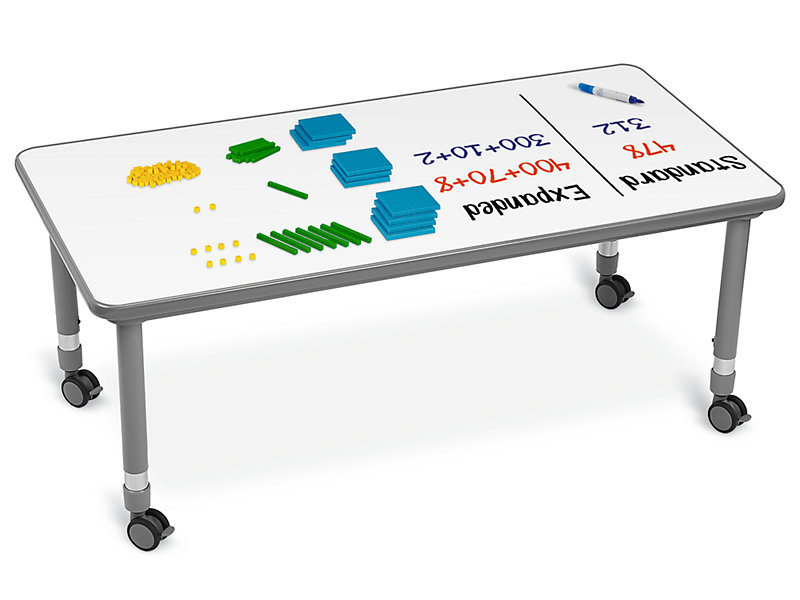
Another thing I would like to add to further foster inquiry-based learning and collaboration is dry erase tabletops. These could be used instead of the white board on the wall by small groups, pairs or even individually to write down ideas without the need of paper.
Now, these tables can be costly but there are other ways around it. Purchasing rolls of dry-erase sheets and then applying that on top of regular tables will also do the trick.
Access to technology is another important element design to consider if we want to foster collaboration and encourage inquiry-based learning. Given the rapid change in our digital era, our learning Commons need to stay on top of this and re-invent themselves in a way that will provide its patrons with everything they need to keep up with the digital world. Technology “can help support a range of social groupings,” (Lippman, 2013) However, we need to remember that having only one tool in the learning commons will not enough to foster learning.
Lippman goes on to add that “to better facilitate a variety of collaborative social groupings, a combination of information technologies can be used to create more than one focal point in the (learning commons.)” (2013). Devices such as tablets, Chromebooks, and computer stations allow learners to have a choice of where to work.
Our Learning Commons has a set of 7 laptops ready for student use. They are kept in our office and can be signed out for the day. We also have a laptop cart and an iPad cart that can be taken to other rooms. Students and staff have online access to a vast number of district-approved resources which can be accessed at school and at home (students need to get the password from us). Resources like “WorldBook Online, National Geographic, Curio, Learn360, and Explora” are available for anyone in the district.
.
One of our two Ipad carts teachers can sign out for their rooms
5 of 7 laptops that can be signed out from the Learning Commons
Some good sources Teacher Librarians can use when thinking about designing or re-designing their Learning Commons are:
1)Designing a School Library Media Center for the Future 2nd Ed, by Rolf Erikson and Carolyn Markuson (2007)
Erikson and Markuson give handy tips, illustrations, designs, and floor plans teacher librarians can use when thinking about designing a Learning Commons that will meet our learners’ needs. Together, the authors have helped create more than 100 media center building projects around the United States.
2)Reimagining Library Spaces: Transform Your Space on Any Budget by Diana Rendina (2017)
Diana Rendina is another good source to have when re-designing our Learning Commons. Her book has tips we can use to efficiently update our library spaces to encourage the use of technology to improve students’ learning.
I have found both sources very helpful whenever my job share partner and I start talking about changing things around our Learning Commons to continue to meet our students’ learning needs. Do you have any other sources to share? I would love to hear them!
2.Discuss the aspects of inquiry design (or re-design) that you find the most rewarding and the most challenging.
Having read more than half of our modules so far for this course has made me realize how important inquiry-based learning is for our 21st century learners. Not only is it engaging students more, but it is also putting them on the front seat of their learning journey; they are the ones who decide how they want to learn about the world that surrounds them. Barbara Strippling puts it beautifully when she says that “inquiry places students at the heart of learning by empowering them to follow their sense of wonder into new discoveries and insights about the way the world works.” (Strippling, 2003 cited on BCTLA, Points of Inquiry, 2011)
Through inquiry-based learning, students are given the opportunity to freely explore topics they are interested in and at the same time, develop their collaboration, communication, critical thinking, and technological skills. It is this “learning through experience” that allows students to not only learn but to also be able to connect what they are learning to the world around them.
One of the aspects I find the most rewarding, yet challenging is “the connect and wonder phase.” Strippling points out that two very important thinking strategies must be used during this stage; they are “asking questions and making predictions” (Strippling, 2004) Furthermore, the BCTLA define this stage as the one where students “develop focus questions, make predictions, and create hypothesis while connecting with their personal experience and drawing on and building their background knowledge.” (Strippling & Harada, 2012). Collette Cassinelli adds that “not only do (student-generated questions) drive the inquiry process, but they also provide evidence of students’ understanding.” (Cassinelli, 2018, p.65) By asking the right questions and connecting them with their previous experiences and knowledge, students can move beyond fact gathering to a deeper level of intellectual exploration. Jean Donham calls this step “the active intellectual exploration” stage and she believes it is “at the (very) heart of any inquiry-based assignment… (and that) by posing the right questions, we can help students distinguish between a research paper and a report.” (Donham, 2011).
But then, what type of questions can we as educators ask that will not only be tied to the curriculum, but that will also push the learning to active investigation and exploration? how can we help our students come up with the right questions? What skills do we need to show them so they can be able to come up with deeper thinking questions on their own? How do we know they’re on the right track?
I believe that connecting to previous knowledge is an important part of the process. Not only will this spark their curiosity, but it will also engage and challenge learners. The AASL standards add that inquiry is “built on the prior knowledge of students, exploration of misconceptions, and critical thinking. (Fontichiaro, 2009) This is the part that I find the most challenging, not only do I have to plan for moments that will allow students to create research questions rather than fact gathering questions, but also accepting that it will take time for students to access that prior knowledge and to start connecting the dots with the new concepts they are learning. Not only that, but to also be able to give students enough freedom for them to take ownership of their own learning by selecting how they want to learn. All this will require a change in my teaching practice, I will have to start letting go of the reins and allow students the time they need to investigate, connect, make mistakes, ask questions, and get off track. I believe this will be the most challenging part of my journey into inquiry-based learning. I think that what I need to remind myself when I feel like I am losing control is that one of my main goals is to provide opportunities for my students to be highly engaged and succeed. There is no bigger reward than so see our students go through all the stages of learning, from curiosity to accomplishment when they are able to grasp the concepts they are exploring.
Reflecting on what I find most challenging made me remember last term when I truly experienced Inquiry based learning during my LIBE 477 course. At first, I felt lost and overwhelmed because I had never been given a carte blanche to explore what I wanted to learn. I have always been given specific assignments with very detailed rubrics, and even when I did inquiry in the classroom, it was all teacher-led. I guess I am truly afraid of letting go of that control as a teacher. This experience also made me feel that I was so far behind and that some of my colleagues had the inquiry-based learning process down pat. Strippling reminded me that it's ok and that even though “it may seem as if other people have this information down pat and are way ahead of you,” you cannot be discouraged and give up. This shift into inquiry-based learning “takes time, commitment, and thoughtful planning.” (Stripling, 2004). Going back to last term and reflecting on the process, I cannot emphasize how important it is to let our students feel a little lost at first, this to me is what begins the Wonder Stage. Once you come up with your questions and start researching, it’s like a door opens and each of us gets to choose whether to go in slowly or kick that door right open. I chose the first and I’m not ashamed to admit that I was very cautious. When I finally got my questions and started going, it felt so liberating and exciting…I felt like I was truly doing something great! I was learning what I wanted to learn and just couldn’t stop finding more information to learn. I was so proud of my final product and all the things I learned…I did not feel like I was taking a course at all! IBL allows students to dive into their curiosity and take ownership of their own learning. That’s what I want for my students, that’s why even though it is so challenging to come up with the right questions to help them begin the Wonder and Connect stage, it is so worth it when you see students being successful and actually enjoying learning.
Part 2: Inquiry Models: the good, the bad, and the ugly…
3.Use your own information search process to identify an additional inquiry model. Discuss the additional model and compare it to one of the three Canadian models listed in Module 9.
There are a few inquiry models out there; as usual, I started with a simple google search which gave me over 383,000 results…talk about information overload! After a few (and by that I mean about 2 hours’ worth of clicks) I settled upon the 5 Es Inquiry Model.
So, what is the 5Es Inquiry Model?
Designed by the BSCS (Biological Sciences Curriculum Studies), this model follows the “natural pattern of problem-solving,” where individuals become engage in a situation/problem, explore it, develop an explanation about it, then they extend that explanation by applying it to other scenarios or situations, and finally they evaluate their explanation based on how useful it is to their current dilemma. According to Bybee& Landes, the 5E Inquiry Model is based “upon cognitive psychology, constructivist-learning theory, and best practices in science teaching.” (1990). Bybee also adds that “using this approach, students redefine, reorganize, elaborate, and change their initial concepts through self-reflection and interactions with their peers and their environment. Learners interpret objects and phenomena and internalize those interpretations in terms of current conceptual understanding.” (Bybee, 1997, p.176).
This inquiry model leads students through 5 phases: Engage, Explore, Explain, Elaborate, and Evaluate (see figure 1). I have also attached a video if you would like to learn more about this inquiry model.
The first stage of the 5E model is called Engagement. During this stage the teacher’s job is to assess students’ prior knowledge by introducing a scenario that will create a desire to learn about the upcoming topic. This is done through discrepant events, videos, demonstrations, or graphic organizers (to name a few). Students are also to work collaboratively with others to brainstorm and record what they already know as well as to ask questions and make predictions. This stage is similar to the Connect and Wonder stage from the Points of Inquiry model. The BCTLA notes that this stage is where students can access their prior knowledge about a topic, and with the use of strategies and tools such as K-W-L charts, mind mapping, peer questioning, book talks, think-pair-share, etc. students can start “identifying issues worthy of investigation.” (BCTLA, 2018)
The Exploration and Investigate stages are very similar in that they are both student-centered and incorporate active exploration. During Exploration, students are encouraged to “observe, question, investigate, test predictions, hypothesize, and communicate with one another” in order to test their prior knowledge. (Duran & Duran, 2004). Similarly, the Investigate stage is where students start gathering information through multimodal sources. According to the BCTLA, some of the strategies needed for this stage are very similar to the ones used for the 5E model: observe, question, analyze, investigate, and communicate. Both stages have the teacher in the role of “facilitator or consultant,” their job is to challenge students’ prior knowledge through open-ended questions.
The Construct stage of the BCTLA model is very similar to the Explanation stage from the 5Es model. During these stages, students are asked to describe their understanding, evaluate and expand their ideas, draw conclusions, “develop a working plan or outline that supports the main idea and organizes the subtopics or supporting details logically,” and create questions. (BCTLA 2018). In these phases, teachers will assist students by clarifying misconceptions and continuing to ask open-ended questions to promote deeper understanding of the concepts being learned.
The next phase in the 5Es model is called the Elaboration phase. The main focus of this phase is to give students the opportunity to apply what they have learned, this in turn will help them develop deeper understanding of the concepts being learned. In this stage, teachers have the choice of asking students to create a presentation or further investigate to reinforce new skills. Furthermore, students are also encouraged to create a product that will allow them to apply their new skills to other disciplines. This is turn is a great opportunity to integrate science with other content areas and to use technology whenever possible. This phase is very similar to the Express stage from the BCTLA model where students are expected to create a final product to present to an audience. In this stage, students become the teachers and they have full control of how they present their information; they are free to use a variety of media and formats to share their learning. moreover, it is important to note that the 5Es model is very flexible and dynamic in the sense that teachers are free to repeat the explore/explain phases as many times as needed before transitioning to the Elaboration phase.
The final stage of the 5Es model is the Evaluation phase. This is one of the phases that has the most differences when compared to the BCTLA model. The 5Es model allows room for both formal and informal assessments during this phase. The evaluation process may take the form of a quiz, test, or writing assignment as well. It is only during this phase that teachers can observe their students and see if they have a complete grasp of the concepts learned during the lesson(s). Students may also have the opportunity to conduct self-assessments and peer-assessments. The Reflect phase is a little different in the sense that assessment is ongoing throughout the whole inquiry process. Students can keep a journal of their learning, have interviews with the teacher, ask for feedback from classmates and reflect on what is working and changing what isn’t.
Finally, looking at both models we can see how very similar they are regarding the general process of inquiry. Both models emphasize how important it is for students to learn through exploration. I believe that one of the biggest differences lies within the assessment portion of the process. The 5Es model relies not only on the final product but also on tests, quizzes and written assignments, whereas the BCTLA assesses mostly through reflections, interviews, and how students learn and collaborate with one another.
Personally, I like the BCTLA model better as it tells us what students will be able to do through every phase of the process. I also like how reflection plays a big role throughout the whole process and how it is mainly student-centered. The 5Es model is mostly student-centered except for the Explanation phase where teachers take the lead and the process switches from “hands-on” to “minds-on.”
No matter what model you choose when teaching, you must remember that “inquiry is a style of teaching and learning in which the process of learning is valued as much, if not more, than the end product.” (Nathan, Maker Ed Initiative, 2015)
Until next time,
The Duchess of Bookington
Works cited:
Part 1
Cassinelli, C. (2018). Inspiring Curiosity: a librarian’s guide to inquiry-based learning. International Society For Technology In Education.
Erikson, R., Carolyn Bussian Markuson, & Proquest (Firm. (2007). Designing a school library media center for the future. American Library Association.
Lippman, P. C. (2013). Collaborative spaces. T H E Journal 40(1): 32-37.
Maniotes, L. K. & Kuhlthau, C. C. (2014). Making the shift. Knowledge Quest 43(2): 8-17.
Rendina, D. L. (2017). Reimagining library spaces: transform your space on any budget. International Society for Technology in Education.
Stripling, B. K. & Harada, V. H. (2012b). Designing learning experiences for deeper understanding. School Library Monthly, 29(3): 5-12.
Stripling, B. K. (2004). Using inquiry to explode myths about learning and libraries. CSLA Journal 28(1): 15-17.
Bybee, R. (1997). Achieving scientific literacy: From purposes to practices. Portsmouth, NH: Heinemann Publications.
Bybee, R., & Landes, N. M. (1990). Science for life and living: An elementary school science program from Biological Sciences Improvement Study (BSCS). The American Biology Teacher, 52(2), 92-98
Maker Education Initiative. (2015). Maker Ed: The Impact of Maker Education [YouTube Video]. In YouTube. https://www.youtube.com/watch?v=3Ml9j1UkeI4
The Points of Inquiry. (2018, October 23). BC Teacher-Librarians’ Association; BC Teacher-Librarians’ Association. https://bctla.ca/resources/point-of-inquiry/



 .
. 


No comments:
Post a Comment