For years, I thought it was a person who loves books, loves reading, and will always know the answers to your questions or at least where to find them in a book. The Oxford dictionary defines a librarian as “a person who is in charge of or works at a library.” (Oxford, 2023) On the other hand, The Collins Dictionary defines them as people “who are in charge of a library or have been trained to work in a library.” (Collins, 2023). To be honest, these definitions are so vague it really makes you wonder if people outside of the profession actually know what the role of a librarian is. Even as a teacher, I never fully grasped the true role of a teacher-librarian until I decided to become one and started learning more.
But what does this role really entail? To be honest, I am still learning, and it never ceases to amaze me how many hats this profession holds. Through my courses, LIBE 467 included, I have learned that a teacher-librarian is:
• The heart of the school: the learning commons and its teacher librarian are like the kitchen in a house, where everyone gathers to experiment, learn, and relax. Their job is to make sure their library is a welcoming place where everyone will feel safe not only to learn but to be who they truly are.
•The person in charge of making sure everyone has equal access to resources: as teacher librarians, our job is to ensure our students’ learning needs are met. We need to provide a variety of multi-modal resources so everyone has a chance to succeed.
•An advocate of equality and freedom: as teacher-librarians, it is our job to make sure we provide a variety of points of view so our patrons can make informed decisions. We are in charge of helping them develop critical thinking skills in this digital era where they have access to an infinite number of resources at the click of a button.
Theme 2 has also taught me that a Teacher-Librarian is a reference advisor (a resource guide), a collection curator, a 21st-century online expert, and a budget allocator. I’m sure that as I continue on my learning journey, I will learn of many more roles TLs have within our school community…if that’s not a superpower I don’t know what is!
Lesson 5: Cooperative Planning – Why Collaboration is Important
As I continue to read through the lessons and weekly discussions, one thing keeps coming up and that is the importance of collaboration in teacher-librarianship. I can now see that this role functions best when there is open collaboration amongst teachers, administration, students, and the whole school community.
Riedling explains the importance of collaboration through the “reference interview.” She states that teacher-librarians can strategically determine what the students want by conducting one-on-one reference interviews, “a conversation between the school librarian and the student for the purpose of clarifying the student’s needs and aiding in meeting those needs.” (p89) As an interviewer, the teacher-librarian’s primary role is to determine “efficiently and productively” the student’s information needs in terms of “the nature, quantity, and level of information the student requires, as well as the most appropriate format.” (Oxley, UBC 2023) She also states that this process is “an essential part of reference services and a major function of all school librarians.” (p89). But how can they achieve this? How do they know if the reference interview was successful?
Furthermore, Riedling tells us that in order to effectively conduct reference services, the teacher-librarian should not only be familiar with both print and digital resources in the collection, but they should also possess great communication skills and be competent at evaluating, organizing, and selecting resources based on their school community’s needs. She also states that the success of the reference interview is not only whether or not the student got the resource they needed, but also how they felt during the process. If they felt that they were given adequate attention as well as accurate resources, then Riedling says that the interview was successful.
The Canadian Library Association, on the other hand, sees the teacher-librarian as the facilitator of collaboration among teachers, students, and the school community. Their document Leading Learning states that the TLs have the role of “facilitating collaborative engagement to cultivate and empower a community of learners.” (p8) The focus here is more on teachers, students, and teacher-librarians working together to learn, rather than just being led to the right resource.
During one of my courses this past semester, I was introduced to the infographic made by the Surrey Teacher-Librarian Association. I find it very useful because it summarizes what Teacher-Librarians can do to foster a collaborative culture in our learning commons and school community. The document also states that the success of the learning commons, and its ability to deliver the services and programs available, “require a higher degree of collaboration” and communication among the Teacher-Librarian and the school community as a whole. (BCTLA, 2019)
Teacher-Librarians also have the responsibility of managing and developing the collection. Riedling describes collection development as “the process of systematically building library collections to serve, study, teach, research, and meet other needs of students and teachers. The process includes the selection and weeding of current and retrospective materials, the planning of strategies for continuing acquisition, and evaluating collections to determine how well they serve user needs.” (p15) She also states that the effectiveness of a collection can be better achieved if the teacher-librarian works collaboratively with key players such as admin, classroom teachers, students, district staff, and the community. Again, Collaboration is seen as a key element in teacher-librarianship.
Other key elements we must mention are time and budget. During our group discussion, I discovered that I am not alone and others share the same feeling of frustration when it comes to time and money! Teacher-Librarians already have so much on their plates, trying to run an effective 21st-century Learning Commons that just adding the thought of also becoming community leaders and advocates for our students with the little time and depleting budget we have, seems almost like an impossible task to achieve.
Riedling states that in order to have a collection that is useful for everyone, “an active and continuous program of weeding must be maintained.” (p17) My job share partner and I have been trying really hard to continue to take time for weeding, even if at times we do it a small shelf at a time due to having to add more prep blocks to our schedule, or having to step in as classroom teachers due to staff shortages. Time to collaborate is also hard to come by!
Empowering Learners: Guidelines for School Library Media Programs states that “the school librarian collaborates with the teaching staff to develop an up-to-date collection of print and digital resources in multiple genres that appeals to differences in age, gender, ethnicity, reading abilities, and information needs.” (AASL, 2017). We certainly have had to be very creative in finding time to talk to our colleagues to see what resources are working and what they would like to see in the SLLC. Talking with students, on the other hand, is a bit easier since we see them in the hallways or at the learning commons more often.
Image Credit: World Book Encyclopedia
The reference collection also needs time and funds to be able to be supported appropriately. We know that our job is to make sure that we are meeting the needs of our students and staff by providing access to various multimodal sources. These can be very costly! A set of printed encyclopedias can cost over $1,000. We also need to take into account that “print encyclopedias should be replaced every five years as the information becomes outdated.” (Riedling, 2019)
When it comes to online resources, we are lucky that our school district has paid for online subscriptions to resources like World Book Kids, National Geographic, Helix, Curio, and Learn 360 to name a few. Each year, TLs are provided with a list of usernames and passwords to access all these online resources; again this is great! However, this also requires the teacher-librarian to teach staff and students how to gain access. My job-share partner and I have taken time during staff meetings to present one resource at a time, so we do not overwhelm our teachers. We have also offered to come and show classes how to access these at home. Ideally, we would like to collaborate with classroom teachers during projects so we can show students (and teachers) the benefits of having access to these amazing resources. As K. Oxley suggests, it is the teacher-librarian’s “responsibility to ensure that a resource is used and used well in an ongoing way. In order to ensure effective spending of budgets, it is essential that the entire collection be used on a regular basis by students and teachers, and this includes the reference section.” (Oxley, 2023)
Lesson 7: Evaluating Information Services
Image Credit: Creative Commons
Evaluation of a library service is not as simple as stating what is working and what needs improvement. It is more complex than that. Riedling asserts that in order to provide top-quality resources and reference services, a teacher-librarian must be aware of the needs surrounding their school community and be able to select, organize, and evaluate resources that will meet those needs.
Evaluating reference services (as well as the entire collection) is important because it allows the teacher-librarian to be fully aware of how much and how well references and reference services are used by members of the school community. (UBC, 2023)
According to K. Oxley, the following steps must be included in any evaluation of reference services:
•A statistical evaluation (raw data) of how much the reference materials are being used
•A satisfaction survey from all patrons using the services.
•An evaluation of the Teacher Librarian’s role after delivering the reference service
•Peer evaluations
•Administrative evaluations of the library program as a whole
•Self-reflection/self-evaluation
(Theme 7 LIBE 467, UBC, 2023)
This theme has touched on yet another layer in the teacher-librarianship job. It never ceases to amaze me how much difference we can make in our school community through collaboration, effective management of the collection, and evaluations of the reference services. I continue to be humbled by everything I am learning on this Teacher-Librarianship journey; one thing I know for sure…no task is too big or too small for a TL, Teacher-Librarians are definitely superheroes!
Asselin, Marlene, et al. Achieving Information Literacy Standards for School Library Programs in Canada. Canadian Association for School Libraries, 2003.
I appreciate the approach you took to this blog post — particularly the investigations into definitions of TLs from what are credible sources. I agree with you that the vagueness of these do not begin to represent the detail of the role.
That the librarian is “the heart of the school” is a beautiful metaphor. With the shift to a inquiry hub — or learning commons — not only is the TL and library the leading advocate on information and literacies, but it is becoming the gathering place of the school. It is an inclusive space, which cares for all who enter.
With your thoughts on collaboration, it had me thinking of the TL as the brain of the school: it connects all of the extremities, and acts as a conductor of information.
I was just introduced to this infographic as well (the BCTF New Teachers Conference had a wonderful workshop run by BCTLA’s Tammy Le and Lisa Seddon). I love the ecology represented in the infographic, demonstrating how one leads into another.
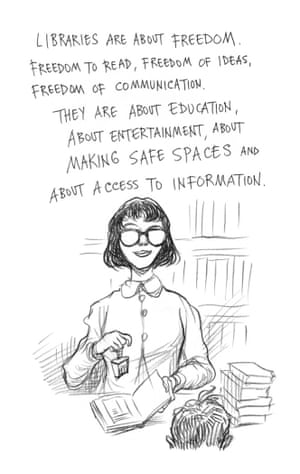
Thank you also for sharing Gaiman’s visual essay: it is inspiring!


Hello Karla,
ReplyDeleteI appreciate the approach you took to this blog post — particularly the investigations into definitions of TLs from what are credible sources. I agree with you that the vagueness of these do not begin to represent the detail of the role.
That the librarian is “the heart of the school” is a beautiful metaphor. With the shift to a inquiry hub — or learning commons — not only is the TL and library the leading advocate on information and literacies, but it is becoming the gathering place of the school. It is an inclusive space, which cares for all who enter.
With your thoughts on collaboration, it had me thinking of the TL as the brain of the school: it connects all of the extremities, and acts as a conductor of information.
I was just introduced to this infographic as well (the BCTF New Teachers Conference had a wonderful workshop run by BCTLA’s Tammy Le and Lisa Seddon). I love the ecology represented in the infographic, demonstrating how one leads into another.
Thank you also for sharing Gaiman’s visual essay: it is inspiring!